Related: The Cyborg Manifesto
”The Cyborg Manifesto” and Cyberfeminism
- Haraway highlights the shortcomings of feminism by reconceptualizing questions of gender and identity in the context of technology. She uses the cyborg, as a metaphor to explore the boundaries between human/machine, nature/culture, physical/nonphysical.
- The goal of text, which Harway admits is utopian, is to imagine a world without fixed categories like race and gender.
- Haraway’s essay is a product of its era. The introduction of personal computers and the internet, was changing how people related with technology.
- By the 1980s, feminism was grappling with internal critiques about the need to recognize diversity among women, not just middle and upper class white women.
- This led to third wave feminism (beginning in the early 1990s) and intersectionality, which complicated womanhood by considering how race, class, and sexuality intersect with gender.
- Haraway’s text can be seen as a response to these debates.
- The concept of the cyborg comes comes from the field of cybernetics, an approach to sociology which views societies and social organizations as complex systems with interconnected parts, which regulate, communicate, and balance each other.
- For Haraway, to call someone a cyborg is simply to recognize their positionality and sublimation into a broader system of ideas, technologies, and institutions, which regulate social life.
- “positionality”: a person’s position within various systems, such as cultural, political, technological, and economic systems. No one exists outside these systems.
- “sublimation”: how individuals are absorbed into and shaped by overarching systems—like governments, corporations, and cultural norms— that govern how we think and act.
- Put simply: For Haraway, calling someone a cyborg means recognizing that they are shaped by and part of larger systems of technology, ideas, and rules that structure society.
- Haraway defines a cyborg as, “A cybernetic organism, a hybrid of machine and organism, a creature of social reality, as well as a creature of fiction.”
Donna Haraway’s Cyborg Metaphor
- Definition: A cyborg is a hybrid, blending the organic and mechanical. It blurs boundaries between human/machine, physical/non-physical, and natural/artificial.
- An identity that is fluid, multiple, and constructed, challenging essentialist views of identity, such as fixed notions of gender and race.
- The cyborg disrupts binary oppositions and promotes an understanding of identities and relationships as complex and intertwined.
- The cyborg symbolizes a positive and active engagement with technology, seeing it as integral to our identities and experience.
The cyborg emerges at the intersection of the three major social and technological boundary breakdowns of the late 20th century.
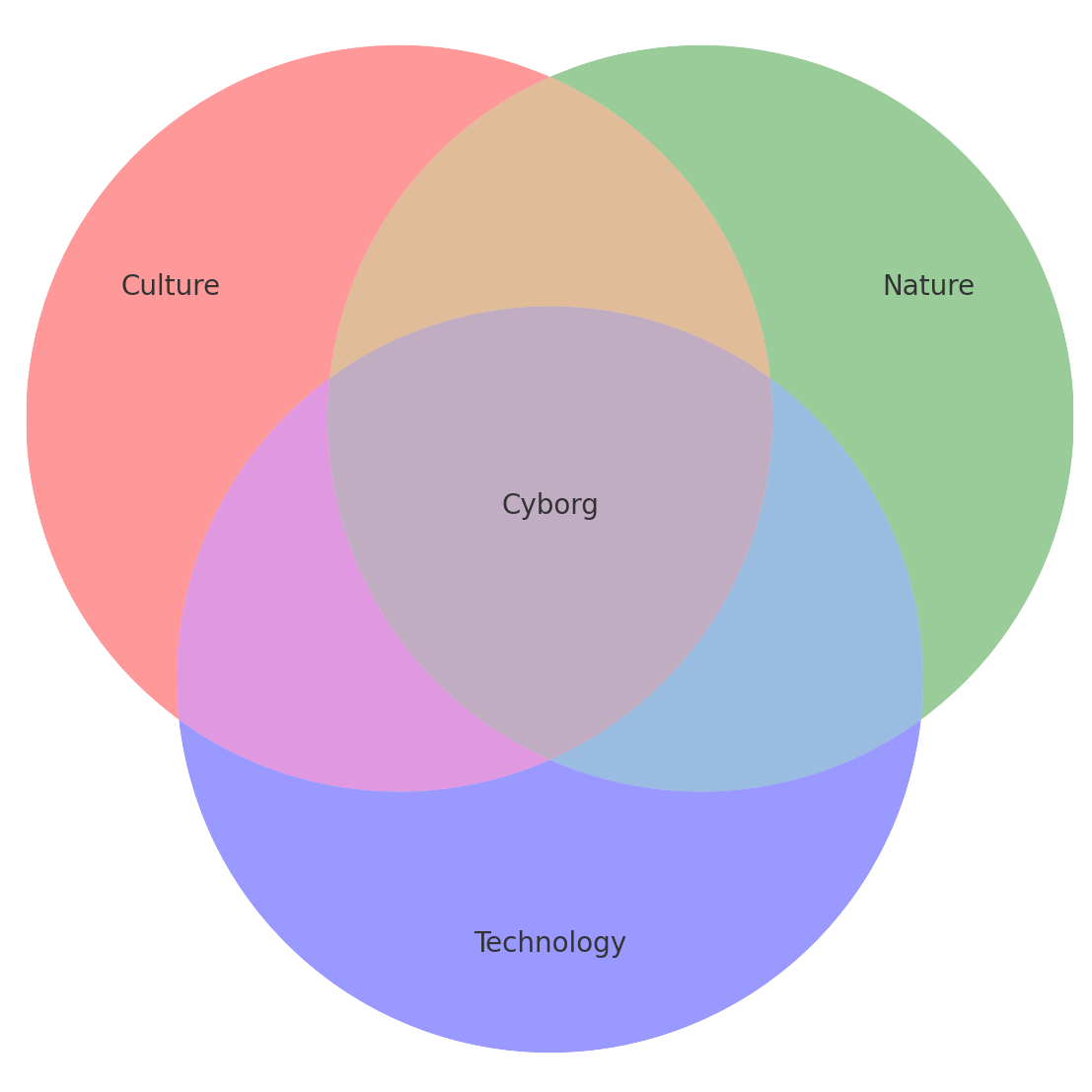
Breakdown: Human and Animal
- The line between humans and animals has been crossed by various biotechnologies.
- The theory of evolution has blurred the distinction between human and animal.
- Animal rights movements are recognition of connection across the “breach” of nature and culture.
Breakdown: Human and Machine
- With the advent of cybernetics and other technologies, living organisms can be seen as information systems or biotic components.
- Machines themselves are increasingly taking on life-like qualities. This seems even more evident today with AI and machine learning.
Breakdown: Physical and Non-Physical
- Advancements in digital and information technologies, have significantly blurred this boundary.
- We interact in virtual spaces, form communities online, create and experience digital representations of ourselves.
- We even work and create online, this was especially apparently during the pandemic when everyone was working from home.
Harway’s work was also, in part, a reponse to Marx.